
EHS Drone Strike Takes Out Unauthorized Hot Plate

BERKELEY, CA—Confirming the department had “no choice but to act decisively,” UC Berkeley Environmental Health & Safety officials announced Tuesday that a precision drone strike had successfully neutralized an unauthorized hot plate operating in a third-floor laboratory of Hildebrand Hall.
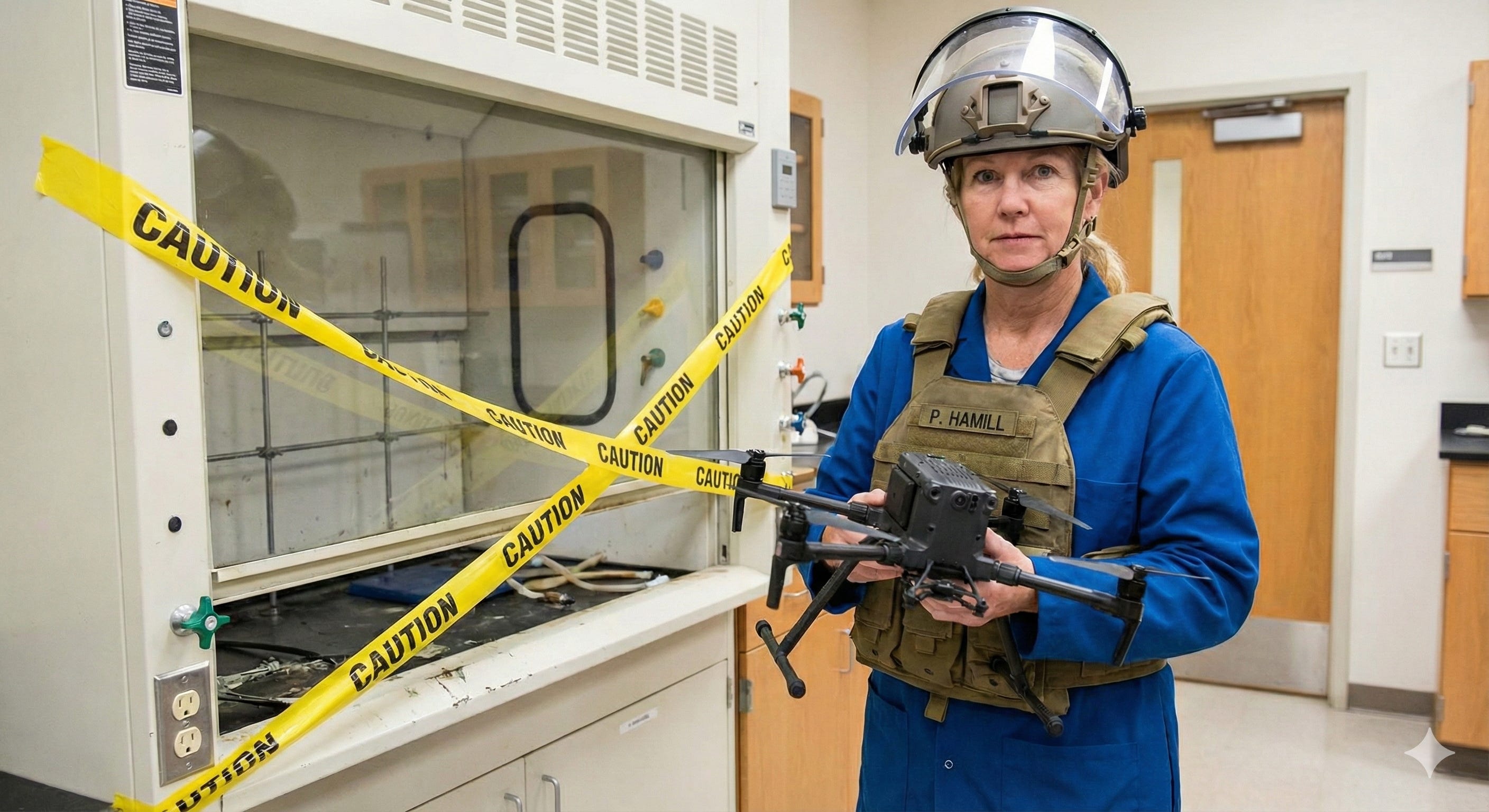
“At 14:32 hours, EHS surveillance detected an unauthorized heating element in room 312,” said EHS Director Patricia Hamill, standing before a screen showing grainy thermal footage of the device. “The hot plate was operating without a current inspection sticker, in a space not rated for heating operations, within eighteen inches of a paper towel roll. We made the call.”
The strike, carried out by a modified DJI Mavic equipped with a small explosive payload, destroyed the hot plate along with approximately $4,200 in glassware, a nearly-complete natural product synthesis, and the will to live of graduate student Kevin Marsh, who was heating a reaction at the time.
“I stepped out to use the bathroom,” said Marsh, 27, surveying the smoldering remains. “I was gone maybe two minutes. I heard a sound like a loud pop, and when I came back, my round-bottom flask was embedded in the ceiling tiles and there was a small crater where my stir plate used to be.”
Marsh acknowledged that the hot plate had not been inspected since 2019 but questioned whether the response was proportionate.
“It was a Corning. A PC-420D. Very reliable,” he said quietly. “I’d had it since my first year. We’d been through a lot.”
EHS officials defended the strike as consistent with the department’s escalating enforcement protocols, which were updated in 2024 to include “kinetic options” for repeat violations.
“We tried the soft approach for years. Emails. Warnings. Gentle reminders about inspection schedules,” Hamill explained. “It didn’t work. People ignored us. Now they don’t ignore us. Compliance is up 340% since we acquired the drones.”
Professor Richmond Sarpong, whose laboratory houses the destroyed fume hood, expressed measured concern about the new protocols.
“I understand the importance of safety,” Sarpong said, picking a shard of a reflux condenser out of his coffee mug. “But I do think there’s a middle ground between ‘email reminder’ and ‘explosive drone.’ Maybe a strongly worded letter. Maybe a fine. Maybe not a missile.”
EHS officials dismissed such criticism as “exactly the kind of permissive attitude that leads to hot plate proliferation.”
“Today it’s an uninspected hot plate. Tomorrow it’s an oil bath left unattended overnight. Next week, someone’s running a rotovap without the shield down,” Hamill said. “You have to draw a line. The line is enforced from the air now.”
At press time, Marsh had been issued a citation for “failure to maintain situational awareness” and informed that his laboratory privileges were under review pending completion of a mandatory 40-hour retraining course titled “Hot Plates: Privileges, Not Rights.”